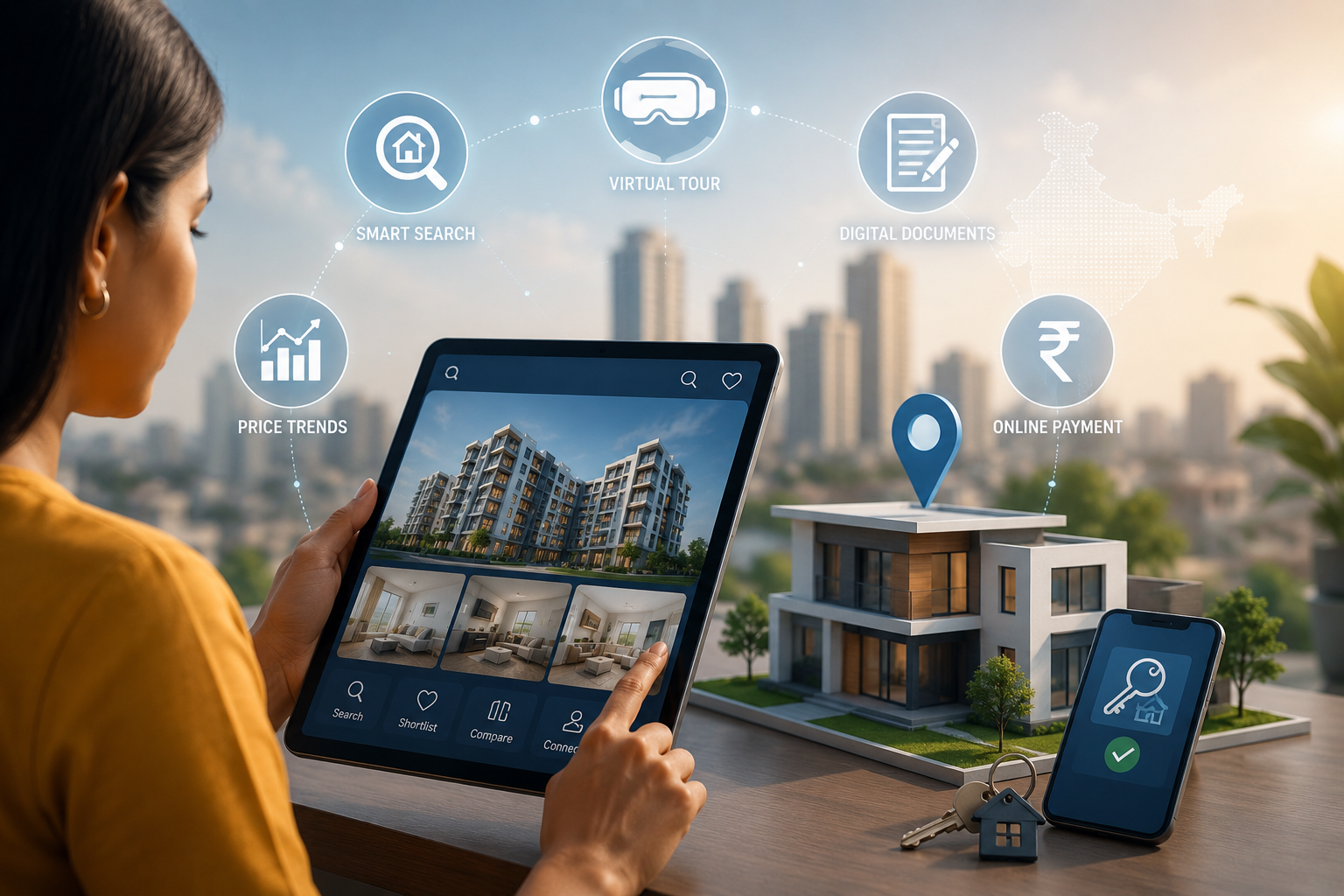
How virtual tours, PropTech dashboards, and smart-home expectations are changing what it takes to buy a home in India — and why human judgment still has the final say.
Introduction
Something quiet but significant is happening in Indian real estate. From Gurugram’s residential corridors to Bengaluru’s emerging tech districts, buyers are no longer relying purely on site visits, broker calls, and gut instinct. Virtual tours, big data dashboards, and smart-home tech have become part of how people search for, evaluate, and ultimately commit to one of the biggest financial decisions of their lives.
So here’s the question worth asking: can technology actually fix India’s notoriously complicated property market — or is it just a shinier layer on top of the same old chaos?
The honest answer is somewhere in the middle. Technology can speed up discovery, shrink the information gap between buyers and sellers, and bring real discipline to evaluation. What it can’t do is erase the complexity of a market that is still deeply human, deeply political, and deeply dependent on execution. Knowing where that line sits is now essential for anyone buying, selling, or investing in property in India.
Why Indian Real Estate Needed a Digital Reset
If digital tools can work in Indian real estate, they can work almost anywhere — because few markets pile on this many layers of friction at once:
- Hyper-local micro-markets, where moving one street over can swing prices by 20%
- Regulatory variation across states, municipalities, and how RERA gets implemented on the ground
- Developer credibility that swings wildly and is genuinely hard to verify
- Infrastructure and approval timelines that sit completely outside a buyer’s control
- Informal pricing and off-the-record negotiation that never shows up in any dataset
That combination makes Indian real estate both a great proving ground for digital tools — and a dangerous place to get overconfident about them. Technology is good at handling complexity. It struggles with unstructured human discretion. And India has that in abundance.
Where Tech Genuinely Earns Its Keep
1. Virtual Tours: Exploring Without the Commute
For most of the last century, house-hunting in India meant physical presence — weekend drives, repeat site visits, and logistics that naturally capped how many properties anyone could realistically compare.
High-resolution 360° walkthroughs, drone footage of neighbourhood infrastructure, and AR tools that let you picture a furnished interior have quietly dissolved that constraint. What started as a pandemic workaround is now just the baseline.
It’s reshaping the search for:
- NRIs evaluating projects without flying home
- Inter-city buyers comparing corridors they’ve never set foot in
- Working professionals squeezing weeks of research into a few smartphone evenings
- Investors weighing multiple cities’ worth of projects at once
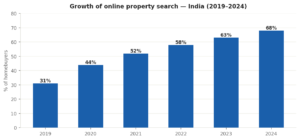
Buyers using virtual tours considered 3.2× more properties — and cut their time-to-shortlist by 11 days on average.
2. Big Data: Trading Gut Feel for Evidence
Real estate has always been an information-asymmetric game. Developers, brokers, and big institutional investors had access to transaction histories, infrastructure pipelines, rental yields, and demographic trends that the average buyer simply couldn’t see. That gap shaped every negotiation in the seller’s favour.
PropTech platforms are closing it fast. Transaction data, RERA filings, land record integrations, and infrastructure trackers are getting packaged into dashboards that give individual buyers something close to institutional-grade research.
Buyers can now dig into:
- Historical price appreciation by corridor and micro-market
- Upcoming infrastructure and connectivity timelines
- Rental demand and yield comparisons across localities
- Developer track records and RERA compliance history
- Commute patterns, traffic density, and proximity to schools and healthcare
The mindset shift shows up in the question buyers ask. It used to be “Is this a good investment?” Increasingly, it’s “What does the data say about this corridor over the next five years?” Assumption is giving way to information. Speculation is giving way to analytics.
3. Smart Tech: Raising the Bar on What a Home Should Do
Technology isn’t just changing how homes get bought — it’s changing what buyers expect once they move in. Smart locks, video-enabled security, IoT appliances, voice-controlled lighting, and app-based home management were luxury extras five years ago. Now they’re closer to standard issue.
Today’s buyers are actively looking for:
- Smart door locks and video-enabled security
- Motion sensors and automated access control
- Voice-controlled lighting and energy-efficient automation
- IoT-enabled appliances and mobile home management
- EV charging and solar integration
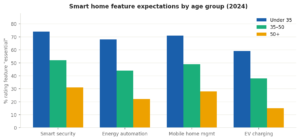
For millennial and Gen Z buyers — now the largest group of first-time homebuyers in urban India — these aren’t nice-to-haves. They’re evaluation criteria, sitting right alongside location and price. The home is quietly evolving from a physical asset into an intelligent living environment.
The Bigger Shift: It’s Restructuring the Market, Not Just the Search
Tier-II Cities Are Catching Up Fast
Maybe the most consequential change is geographic. Better mobile internet, cheap smartphones, UPI payments, and government digital-records initiatives have pushed information access well beyond the metros.
Buyers in Nashik, Bhubaneswar, Coimbatore, and Indore can now pull up verified listings, check digital land records, confirm RERA status, and apply for home loans — all things that used to require a trip in person or an intermediary who knew the system.
Source: NASSCOM-KPMG India PropTech Landscape Report 2024
Transparency Is Now the Real Competitive Edge
For years, the biggest buyer complaint in Indian real estate was the same: project delays, hidden costs, unclear approvals, no real visibility into what was actually happening. Digital documentation, real-time construction tracking, customer reviews, and publicly accessible RERA data are finally chipping away at that.
Developers who lean into openness are building trust faster than those still relying on traditional marketing. In a market this information-driven, that gap is only going to widen. Trust is becoming digital.